
Has authenticity gone too far?
When “speaking your truth” starts to look a lot like being a jerk.

“Authenticity” has become one of the hottest buzzwords in recent years – even trending harder than Sydney Sweeney’s chest (if you can believe it)!
It’s hailed as the new holy grail: the cure to curated lives, polished filters, and endless pretending.
Celebrities name-drop it in interviews, influencers brandish it like a personality trait, and LinkedIn posts practically come with a ‘Certified Authentic’ badge.
It’s so zeitgeisty, I’m surprised Gwyneth Paltrow didn’t name a child Authenticity.
It’s what we’re all trying to be more of.
But has it gone too far?
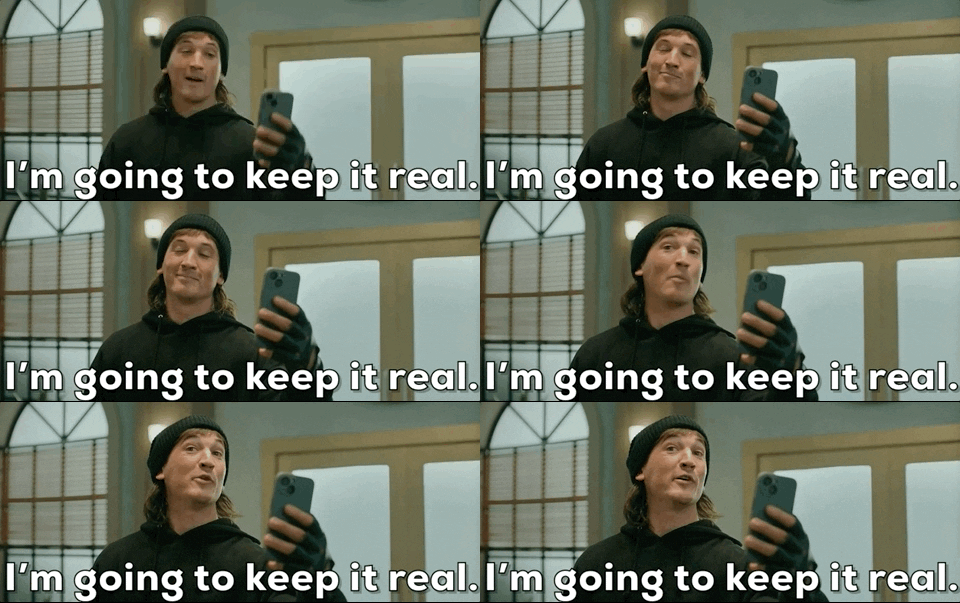
Merriam-Webster defines authenticity as “the quality of being true to one’s own personality, spirit, or character.”
But somewhere along the way, it’s gotten an interesting “rebrand.”
People are now bending authenticity to their will, using it as an excuse to be an asshole and calling it their “authentic self.”
It’s less of a virtue and more of a loophole.
Somehow, authenticity’s been confused with audacity.
And sadly, we’re letting it happen.
The audacity of people these days never ceases to amaze me.
Sell something on Facebook Marketplace, and you’ll see exactly what I mean.
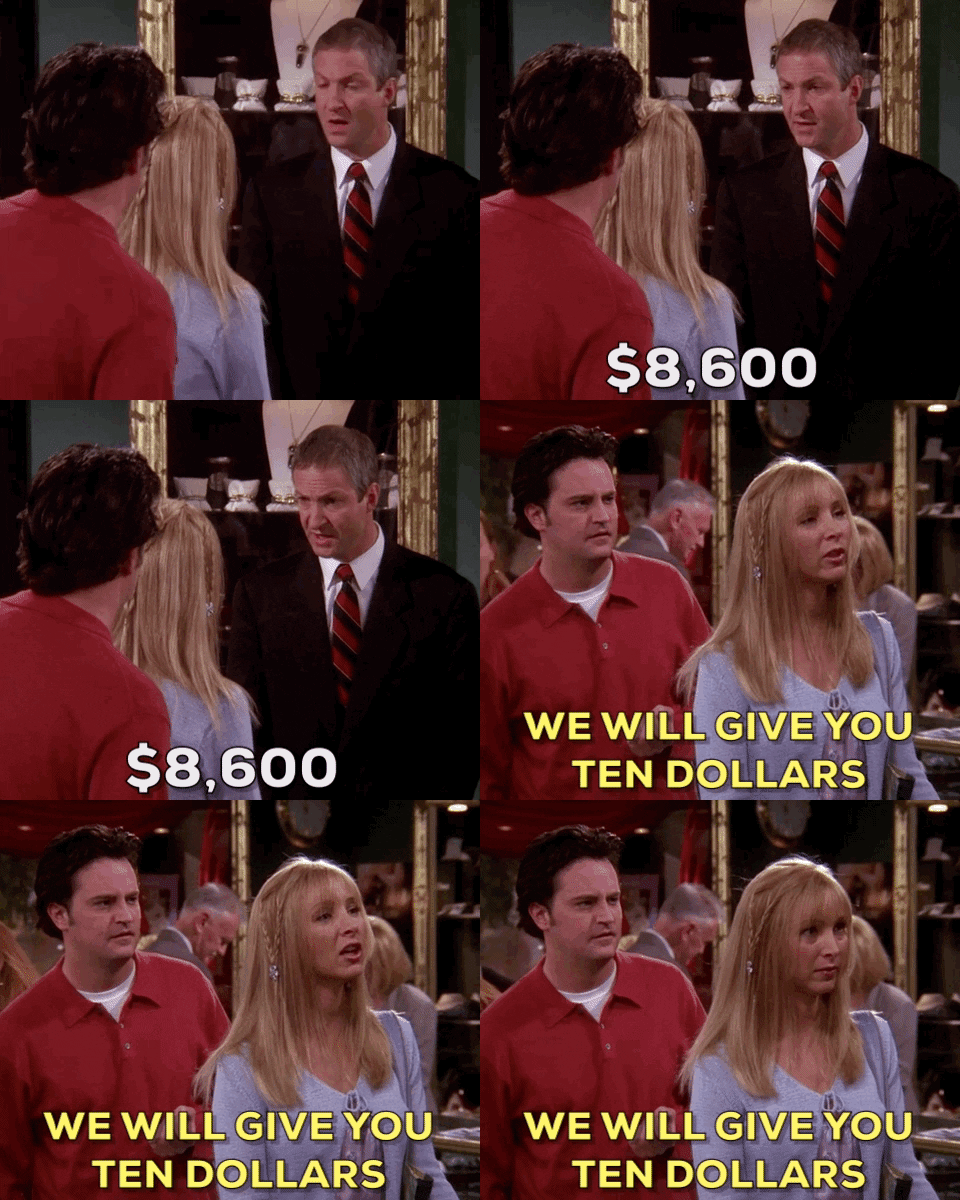
“Your couch is $100? I’ll give you $5.” Sure, how could I possibly resist such an offer?
“Pick-up only? But I live an hour away. You’ll need to deliver it to me. For free!” Absolutely. And hey, I’ll swing by the grocery store and grab your shopping while I’m at it.
“What are the exact measurements? Weight? Year? Why are you selling it? Are there any scratches on it? Is it from a smoke-free home? Can you send a photo of the underside? Would it fit in my car? What’s your lowest price?” Mate, it’s a $10 item. Not a deposit on a house.
And that’s just the tip of the iceberg.
Because apparently, audacity and entitlement have merged, birthing a whole new species.
It’s a mutation. A super-virus I’m desperately hunting a vaccine for.
You know the type.
They act like civilization exists to serve only them, where everyone else is just an unpaid extra in their solo production.
They’re never satisfied (only placated), constantly scanning the horizon for the next thing they deserve.
And their belief system is simple: if it came from my truth, then it shouldn’t have consequences – and anyone who disagrees “hasn’t done the work.”
But let’s rewind for a second, because authenticity did look like progress at first.
We went from:
“Hide your true feelings.” “Be polite.” “Don’t rock the boat.”
To:
“Speak your truth.” “Be yourself.” “Dont apologise for who you are.”
That shift felt genuinely refreshing (even liberating) after years of repressed social conditioning.
Like the emotional equivalent of taking off your bra at 5pm.
But like most things in life, we didn’t stop at healthy.
We pushed it to the extreme.
And what I take issue with is how “authenticity” is used as a moral shield for behaviour people don’t want to take responsibility for.
Being “authentic” has stopped meaning truthful, grounded, aligned, and started meaning “I can say whatever I want, and if you don’t like it, that’s your problem.”
Naturally, this version of “authenticity” is thriving online.
After all, social media platforms are prime real estate to get on your high horse and give a hot take.
(One could argue that’s what I’m using Substack for 😜)
Besides, there’s rewards for being “authentic,” especially on social media.
The more unfiltered, shocking, blunt, or contrarian you are, the more reach and attention you get.
We’ve mistaken bluntness for bravery and started applauding people who “say it how it is,” even when they’re just being a knob.
So if you publicly spray your opinion, slap the word “authentic” on it and brace for impact – congrats!
You’ve just earned yourself a “get-out-of-being-cancelled” card.
A convenient tool every modern “truth-speaker” keeps tucked in their back pocket.
And we don’t really have anyone to blame but ourselves.
We wanted relief from inauthenticity so badly that we didn’t notice when we started accepting the wrong kind of “real.”
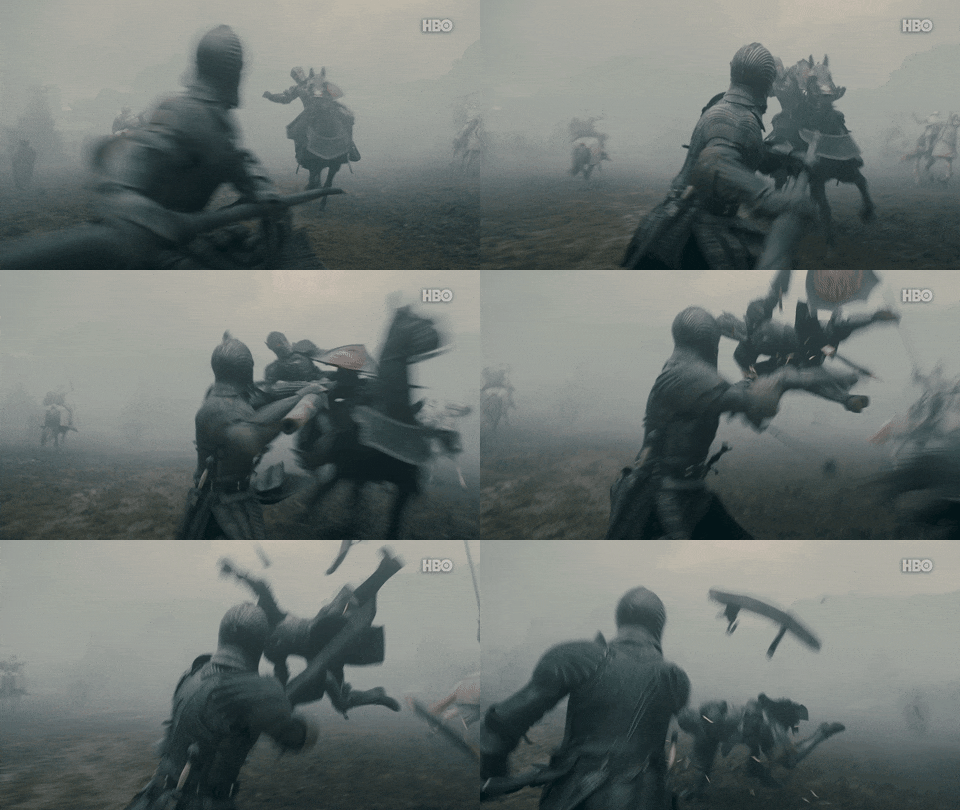
Authenticity rode in like a knight in shining armour. Now it’s slaying everything in its path.
And it seems nobody is willing to challenge it.
Which I completely understand. I mean, who wants to cop the flak from authentic wrath?
We’re in a cultural moment right now where the rules are constantly shifting.
What’s assertive vs rude?
What’s calling out vs shaming?
What’s empathy vs. enabling?
Nobody knows anymore, so the default is to stay quiet and avoid risk.
I think everyone’s terrified that if they speak up, someone will whip out a phone, edit the first 10 seconds, and boom – they’re the Karen.
But there’s a bigger problem brewing.
We’ve got more “authenticity” than ever before, but zero accountability.
We now live in a hyper-individualistic world where “main character energy” is treated like a God-given birthright. Where ruthlessly prioritising “my truth,” “my boundaries,” “my energy,” “my needs,” is slowly bulldozing the collective.
But last time I checked, this is a world we actually have to share with others.
If you’re only looking out for number one, elbowing and climbing over everyone in your way: don’t worry, babe, you’ll make it to the top. But the rest of us will be left broken, battered, and possibly missing a limb.
Don’t get me wrong, I’m all for being who you are.
In theory, more authenticity should equal more humanity, right?
And yet, I feel less of it around.
These days, just being out in the world feels like armouring up for battle.
And naturally, I forgot my helmet. And my full suit of chainmail.
Society already feels like it’s speeding down the “me over we” highway, which is basically a one-way street to We’re-Fuckedville. Population: all of us (sorry).
So have fun with that… I’m going to take the road less travelled.
The one where people still give a damn. Where they still try. Where self-awareness and common decency aren’t extinct.
A mythical place where people understand they’re an individual within a collective.
Where small actions still matter and one ripple can, in fact, become a tidal wave.
I mean, didn’t anyone watch The Butterfly Effect?
Many of us have convinced ourselves we don’t have that much power.
The truth is, what we do on a daily basis touches someone, somewhere. And not in a weird, let’s-get-HR-involved, kinda way.
It all comes down to effort.
Saying the kind thing. Doing the right thing. Showing up as a contributing member of society, even when self-serving, has become the norm.
But it’s easier said than done.
We’re tired, drained, and perpetually disappointed in humanity.
Honestly, my authentic self never wants to leave the house or deal with the general public.
But I worry that if I keep letting myself off the hook just because everyone else is, I may never make an effort again.
It’s a slippery slope… and I’m hovering dangerously close to the edge.
I often ask myself, “Would the world be a better place if everyone were more themselves?”
And I still don’t have the answer.
Part of me wants to say yes. Mostly because politeness compels me – and I’m still a people-pleaser at my core.
Some people genuinely want to make the world a better place. Others want to watch it burn.
And despite spending this entire essay ragging on authenticity, I do think it’s incredibly important.
But only the kind that balances self-expression with responsibility to others.
“Fake authenticity” on the other hand? Sorry sweetheart, the jig is up. Grab your coat and scram.
P.S. If you disagree, that’s fine. Just don’t call it “your truth.” 😉
*P.P.S: I started writing this months ago, and it quickly morphed into this monstrosity “Oh customer service, wherefore art thou?” I could have left it there, but instead of abandoning my original thoughts, I polished it off anyway. And as my Dad would say: “A polished turd is still a turd.” Enjoy :)
“Honestly, my authentic self never wants to leave the house or deal with the general public”
- me everyday
The tragedy of the commons extends to courtesy. The courteous among us respond to discourtesies by turning the other cheek and thereby invite more discourtesy. The discourteous view our courtesy reaction as a complicit acknowledgement that the discourtesy was not effrontery but everyday give-and-take. The givers give and the takers take. Soon there is nothing left for the givers; the takers have taken everything. The economies of Australia, Canada, and the USA bear much blame for this epidemic of ugly behavior masquerading as authenticity. People between the ages of 20 and 40 cannot afford to buy houses, and this disrupts the cycle of marriage and raising children. Ezra Pound held failed capitalism (more specifically bankers) to blame for this social plague during the 1930's, a decade that our time resembles more and more. It is small wonder that you, living in the land that gave us the "Mad Max" franchise, are struck by the appearance of so many misusages of words, so many semantic distortions, a symptom of our new dystopia. One almost has to be numbed or drugged to function at all in our frantic devil-take-the-hindmost societies. Your antennae are too sensitive. They pick up all of the micro-poisons floating in the air. Look at the statistics of mental illness, the caseloads of psychotherapists. You cannot miss the distress signals.